Convey a license unit---To allocate or consign a license unit to an entity, such as an NDS® User object
With the UAL model for NetWare, when a user logs in to the network for the first time, NLS conveys a license unit to a corresponding User object. No license unit is conveyed until a user logs in.
For example, a network administrator has installed a license certificate that contains 100 license units. Of 100 users on the network, only 90 have completed a first-time login to a service. Ten license units remain unconveyed.
Once a User object has a license unit, NLS allows that user to retain it until the User object is deleted or the network administrator specifically revokes that User object's license unit.
Conveying a license unit might differ for other Novell® products, such as ManageWise®.
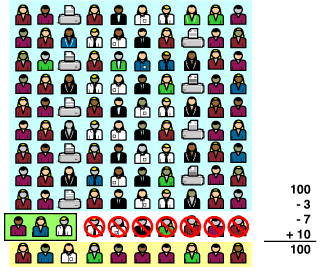
Reconvey a license unit---To allocate a license unit that has been returned to a pool of license units If a previously deleted User object is again assigned a license unit and logs in to a network service, that User object again receives a conveyed license unit (provided one is available). The license unit, conveyed from the pool of available license units, may be a released license unit or any other available license unit. A released license unit returns to the pool of license units. It can be reconveyed. Scenario. At the OptionsPlus company, Sandy installs a certificate that contains 100 license units. Ten employees take extended leave (medical or vacation). Because 10 temporary employees are coming in until the full-time employees return from leave, Sandy:
When the full-time employees return from leave, the Sandy revokes license units from the temporary employees and reconveys those license units to the full-time employees. The following graphic illustrates this flexibility: Primary license unit---A license unit that is conveyed to an object A primary license unit is a user's permanent license unit. It is unavailable to any other user. It does not return to a pool of license units once the user logs out of the network. It can be released and returned to the pool of license units if a User object is deleted or the network administrator revokes that user's license unit. Secondary license unit---An additional license unit that is conveyed to an object that already has a primary license unit A secondary license unit provides multiple license units for a single object. In a UAL environment, a User object is conveyed for each concurrent network login instance. Three concurrent login instances convey two secondary User object license units and one primary license unit. Each time a user logs in simultaneously from multiple workstations, NLS conveys an additional secondary license unit. A secondary license unit returns to the pool of available license units when it is not used for 72 hours. Scenario. You log in to a UAL network and remain logged in. To assist other employees, you log in from two other workstations. NLS conveys a second and third license unit to you. You now have one primary license unit and two secondary license units. During the next three days, you only log in to one workstation; after the third day, the two secondary license units return to the pool of license units. You still have a permanent license unit. Search for a license unit---A function that the License Service Provider (LSP) performs when an NLS client requests a license unit When an NLS client requests a license unit in the UAL model, the LSP first searches the User object's context for an available license unit. If the LSP doesn't find a license unit, it searches up the NDS tree for one. If no license unit is found in the User's context, the LSP searches the server's context for one. Unlicensed User object---A User object that does not have a primary license unit The UAL model allows you to create or maintain more accounts or objects than the number of available license units. You can create a User object but not convey a license unit to that user. Scenario. You install a license certificate that contains 100 license units. Because the company brings in temporary workers when employees take vacation or medical leave, you choose to create and maintain 110 accounts or User objects. (Even though 110 user accounts exist, only 100 users can receive license units.) Hard stop---A function that prevents a user from accessing an application or service A hard stop does not allow unlicensed connections or logging in without a license unit. Users who cannot use the expected application or service receive a message that lets them know
A hard stop is released after a new license certificate is supplied or you otherwise correct the condition that caused the hard stop. Notification---A message indicating a problem concerning compliance or concerning the licensing service NLS provides out-of-compliance and NLS alert notifications. Out-of-compliance notifications are sent when your company exceeds the terms and conditions of the license agreement. UAL sends these notifications to a designated person on the first and any subsequent day that one or more users exceed available license units. These notifications identify
By default, these notifications are sent to the person who installed the affected license certificate. Multiple network users or groups can receive these notifications. The notifications are sent through the NetWare broadcast utility and (optionally) SNMP. If you do not correct out-of-compliance situations, users receive a separate notification. This message explains that the user is unable to use the application or service until the designated person (a name that appears on the user's screen) installs necessary license units. In addition, if you delete a license certificate while a user is using one of its license units, that user receives an out-of-compliance notification. Alert notifications are sent when NLS discovers a problem with the licensing service.