Novell's implementation of the Open Application Server (OSA) model defined in IBM WebSphere for NetWare marks another chapter in the complementary relationship between Novell and IBM. These open standards include HTTP, HTML, and XML for interacting with Java clients; ODBC and JDBC for accessing remote databases; and TCP/IP as the underlying network transfer protocol.
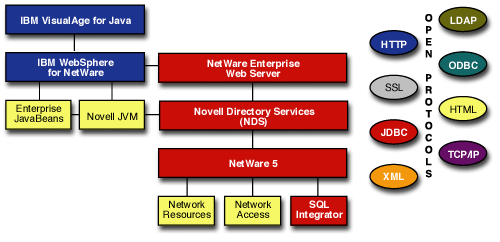
The relationship between IBM and Novell includes NetWare support across additional IBM products such as Netfinity and OS/390 server lines. Both companies strive to deliver open, enterprise-level solutions based on Java and other industry standards. As a result, your company can now take full advantage of the expanding Internet e-business opportunities using open, enterprise-level applications without sacrificing reliability, scalability, performance, security, or manageability.
The Internet is rapidly becoming the de facto network for business information flow and electronic commerce. A major requirement to support this rapid migration to Internet-based business includes an environment that enables the development and deployment of open, distributed, enterprise-level Internet applications.
Because of their business-critical nature, e-business applications must provide high levels of scalability, reliability, performance, security, and manageability. The current generation of application servers does not meet this combination of demanding requirements. That's why the industry is moving to the next generation of application servers based on an Open Application Server model.
The OAS model provides identity-based, managed access to applications and data through a network directory using the SSL and LDAP standards to exchange secure, distributed directory information. The OAS model also provides access to local network services such as cache, database, print, file, and backup, and it provides access to legacy host applications and data. A key defining characteristic of the OAS model adopted by IBM and Novell is based completely on open standards. All network information to and from the application server is communicated using standard protocols.
Another key characteristic of the OAS model is that it provides complete support for the development and deployment of server-based applications using the industry-standard Java programming language. The OAS development environment includes a Java virtual machine and developer tools such as Enterprise Java Beans and a robust development tool set such as VisualAge. A Web application server in conjunction with a Web server provides the Web-based application deployment infrastructure that sends application input/output to Java clients.
One of the most important components of the OAS model is the underlying server operating system. The server runs applications that are fundamental to the business. It is essential, therefore, that the server operating system provide a foundation that has the reliability, performance, and scalability necessary to support business-critical, enterprise-level applications.
Novell has adopted the OAS model to provide its next-generation application server. Novell in collaboration with IBM is ideally positioned to deliver a complete application server environment based on the OAS model.