Managed Object Database (MOD)
The print service manager (PSM) maintains information about itself and the printer agents that it supports. The information is maintained by managed objects in a common managed object database (MOD) and includes the following:
- Access control for PSM managers, printer agent operators, and printer agent users
- Association of each printer agent with specific broker services
- Attributes of the print device or other downstream services supported by the printer agent
- Print jobs processed by the printer agent
- Resources used by the printer agent, such as media and fonts
See the following topics for a description of the various types of NDPS objects:
The MOD is common to all printer agents supported by a single PSM. The information in the MOD is accessed and modified through client requests for both PSM and printer agent operations. When the printer agent runs in an environment where the PSM level operations are not implemented, client access to the MOD is accomplished only through printer agent operations. The MOD also maintains the configuration and supports the operation of back-end components that bind to the printer agent.
The class definitions described in Object Classes represent the syntax of the object types that can be stored in the MOD. For example, a printer agent is represented with a printer object and an input tray on a printer is represented as an input object. The MOD must be able to capture containment relationships among objects such as:
- The Top Tray input object belongs to the Printer Y printer object.
- The Doc 1 document object belongs to the Job 1 job object, which belongs to the Printer Y printer object.
NDPS Objects in NDS
Besides the objects maintained in the managed object database (MOD), NDPS also uses objects in NDS to support directory lookup and access control for three primary components:
| NDPS Component | MOD Object | NDS Object |
|---|---|---|
Printer Agent |
PRINTER |
NDPS PRINTER |
Print Service Manager (PSM) |
MANAGER |
NDPS MANAGER |
Broker |
none |
NDPS BROKER |
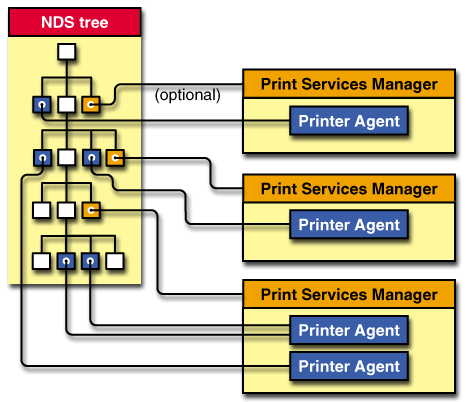
NDS represents these NDPS components because any or all of these objects can be distributed across multiple sites on the network. However, there is no distributed site relationship between PSMs and their printer agents. NDS objects for these components are not used to support distribution over sites, but rather to support distribution over containers within NDS. Each PSM and broker has a single NDS object, but a printer agent can have zero or more NDPS printer objects in NDS.
For example, suppose a PSM has two printer agents and each printer agent has only one NDPS printer object in NDS. The NDPS printer objects representing the first and second printer agents, respectively, can be in different containers.
Also, if one printer agent is associated with multiple NDPS printer objects, those associations are maintained by the NDPS manager object. Multiple NDPS printer objects for a printer agent can be in the same NDS container or in different containers, as shown in the following graphic:
Figure 8NDPS Printer Objects In Different Containers

NDPS Printer Object
The NDPS printer object represents a printer agent and exists in NDS even when the printer agent is not running. The NDPS printer object has attributes which contain information about the printer agent.The printer agent is also represented as an instance of a printer object within the managed object database (MOD).
NDPS printer objects in NDS have the following benefits:
- Clients can perform a filtered search for printers that meet specific service criteria
- NDPS printer objects contain role attributes that list users and operators for the printer
- Print job and document attribute defaults and limits can be customized for the users of each NDPS printer object
Some of the values for the attributes in the NDPS printer object within NDS are duplicated from information stored as attributes in the printer object in the MOD. These attributes are kept consistent and accurate by the printer agent. The duplicate attributes are stored for filtered searching using NDS only.
Some of the NDPS printer object attributes are unique to the NDS object. Each NDPS printer object has an attribute for each role that can be assumed when interacting with a printer agent through that NDPS printer object. There are three basic roles:
The manager's role does not have a role attribute. Instead, it is controlled through NDS access rights to the NDPS printer object and is not used by the print service manager (PSM) or printer agent.
One or more unique print job configurations can be stored as attributes of the NDPS printer object. One of these configurations can be selected when the printer is selected by an individual client. Other attributes are used for NDS specific purposes (for example, lookup, inherited from the device object in NDS, or name-to-address resolution).
NDPS Manager Object
The NDPS manager object represents a print service manager (PSM). It contains persistent configuration information about the PSM. When the PSM is loaded, the PSM authenticates itself to NDS as a specific NDPS manager object in NDS. Attributes in the NDPS manager object are used by the PSM to determine where its MOD is stored. Also, through the printer-to-pa-id-mappings attribute, the PSM determines which NDPS printer objects are associated with each of its printer agents.
NDPS Broker Object
The NDPS broker object represents the broker to potential clients through NDS. In order to advertise itself to non-NDS clients, the broker uses the Service Advertising Protocol (SAP). Each broker searches for other brokers and tries to establish a relationship with each of the other brokers in order to share registry information.