NetWare/
IP Client NetWare Client Comparison
The NetWare/IP client software extends NetWare capabilities to DOS and Windows workstations on TCP/IP networks. With NetWare/IP, NetWare services and applications run the same as they run in IPX-based NetWare environments.
The NetWare/IP client discussed in the following sections refers to a version of the NetWare DOS Requester client, a 16-bit, VLM-based NetWare client, that has been enhanced to include software modules required to access NetWare/IP networks.
In addition to the 16-bit, VLM-based NetWare/IP client discussed in this section, the following NetWare clients can access a NetWare/IP network when properly configured:
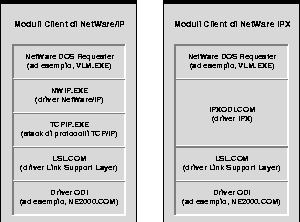
To provide seamless connectivity in a TCP/IP environment, the NetWare/IP client uses the same Link Support LayerTM (LSLTM ) driver, Open Data-Link InterfaceTM (ODITM ) driver, and NetWare DOS RequesterTM as an IPX-based NetWare client. However, to provide the TCP/IP transport, the IPX driver is replaced by the following software modules in NetWare/IP:
Figure 4-5 compares the NetWare/IP client with the IPX-based client modules.
Figure 4-5.
NetWare/
IP Client NetWare Client Comparison
A NetWare/IP client uses values assigned to both local and global configuration parameters to run.
Some local configuration parameters are required, and some are optional.
The NetWare/IP client requires the following local parameter values at startup. All of these required parameters must be configured during installation, unless you are using a Dynamic Host Configuration Protocol (DHCP) server:
The NetWare/IP client may optionally use values for the following parameters to optimize performance:
A NetWare/IP client obtains its local configuration from configuration files or from a Dynamic Host Configuration Protocol (DHCP) server.
The NetWare/IP client configuration is stored in the following two files:
You can edit the configuration information stored in these files using any text editor.
A DHCP server contains a database of client configuration information. If the NetWare/IP client cannot find its local configuration in its NET.CFG file, it queries the DHCP server. The location of the client configuration information is determined at installation. If a DHCP server is not used, you must manually configure the client at installation.
For more information on using a DHCP server, see Configuring a DHCP Server
In addition to the local parameters, the NetWare/IP client also obtains network-wide configuration information from DSS, such as the virtual IPX network number, UDP port numbers for NetWare/IP service, and DSS-NetWare/IP synchronization interval.
To start up the first time, a NetWare/IP client must obtain global configuration parameters from a DSS or NetWare/IP server. The client then saves the parameters to a local file. The next time the client starts up, it again looks for a DSS or NetWare/IP server to obtain the current configuration. However, if it cannot find a server, it defaults to the configuration it used the last time it was running.
The NetWare/IP client requires that TCP/IP be loaded and ready before NetWare/IP can run. When TCP/IP is ready, the NetWare/IP client starts up as follows:
Currently, NetWare/IP imposes the following limitations on client access to NetWare services: