Local and Remote TCP/IP Access
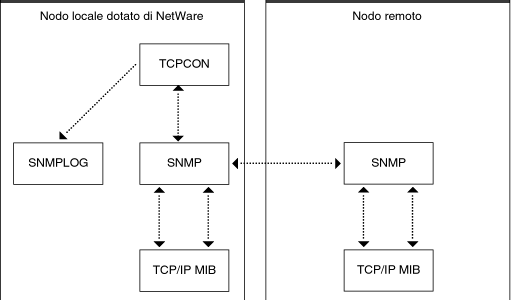
SNMP is the most popular network management protocol in the TCP/IP protocol suite. SNMP lets TCP/IP-based network management clients use a TCP/IP-based internetwork to exchange information about the configuration and status of nodes. The information available is defined by a set of managed objects referred to as the SNMP Management Information Base (MIB). The subset of managed objects that make up the TCP/IP portion of the MIB is maintained by each TCP/IP node. SNMP also generates trap messages used to report significant TCP/IP events asynchronously to interested clients.
TCP/IP supports SNMP access to the complete TCP/IP portion of the MIB, as maintained by the protocol stack. The TCP/IP network management services are provided by the following three NLM files:
SNMP.NLM acts as an SNMP Agent for clients. It presents the standard TCP/IP portion of the MIB and generates trap messages required by the TCP/IP protocol stack. TCPCON is a client of the SNMP Agent NLM. It uses SNMP to communicate with the TCP/IP protocol stack.
SNMPLOG.NLM processes SNMP trap messages directed to the local TCP/IP node and writes them to the following log file:
SYS:ETC\SNMP$LOG.BIN
This log file includes both SNMP trap messages generated locally by SNMP.NLM for reporting local events and those sent from remote nodes for reporting remote events.
TCPCON provides a menu-driven interface for probing the TCP/IP MIB and lets the console operator look at the local trap log maintained by SNMPLOG. TCPCON can effectively monitor either the local node's TCP/IP stack or a remote TCP/IP stack.
To access the TCP/IP MIB information about the local node, TCPCON uses SNMP. TCPCON uses SNMP over UDP or the Internetwork Packet ExchangeTM (IPXTM) protocol to access information about a remote node. Figure 2-28 shows the local and remote access methods.
For information about TCPCON, refer to Novell Internet Access Server 4.1 Troubleshooting and Novell Internet Access Server 4.1 Management and Optimization.
Figure 2-28.
Local and Remote TCP/IP Access
SNMP.NLM performs the SNMP Agent services required by the TCP/IP module. It provides SNMP managers, such as TCPCON, access to TCP/IP protocol stack-managed objects. It also generates SNMP trap messages used to report significant TCP/IP events.
SNMP.NLM provides load-time parameters for establishing the community name used during SNMP message authentication. The community name contained in a request message from an SNMP manager client must match the name established by the agent. The agent discards any request message that contains an invalid community name and does not generate a response to the manager client. By default, SNMP.NLM provides the monitor community name "public," which is used for read-only SNMP requests. Also by default, it disables SNMP write requests. In addition, SNMP.NLM provides a default community name used during SNMP trap message generation.
You can configure any of three SNMP community name options in NIASCFG. The community name options are as follows:
Each option sets the community name for the indicated community. Community names are used to authenticate SNMP messages received by the agent. The community name in a message requesting a given access type must match the name defined for that access type by one of the SNMP community options.
To log SNMP trap messages received by the local TCP/IP node, load SNMPLOG.NLM after loading TCPIP.NLM. SNMPLOG.NLM writes all arriving SNMP trap messages to disk once it is running. SNMPLOG is a background process that does not provide a console interface. If you do not require trap message logging, or if trap messages are being directed to another TCP/IP node, you must not load SNMPLOG.NLM.
Trap message information is written in binary form to the file SYS:ETC\SNMP$LOG.BIN. No size restriction is placed on the log file. To avoid consuming excessive disk space, you should delete the file periodically. If the file does not exist when a trap message is received, SNMPLOG creates it. The log file contents cannot be read by a text editor; however, you can view or delete each log entry in the file by using the appropriate management console (for example, TCPCON, IPXCON, PPPCON, FRCON, and so on).
TCPIP.NLM sends trap messages to the local node unless you specify a remote SNMP manager during TCP/IP protocol configuration (using NIASCFG). In other words, unless otherwise instructed, each node logs its own traps. Specifying an SNMP manager redirects traps to some other node.
The trap address can be set to the same server on all nodes. If this is done, all trap messages from all SNMP Agents can be logged at a single node.