Connecting Two Autonomous Systems
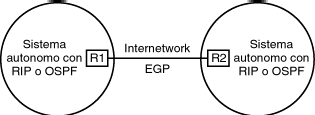
The largest unit in an internetwork topology is an autonomous system (AS). An AS is a collection of networks and routers that exchange routing information using a routing protocol, such as RIP or OSPF. The routing protocols used within an AS are called Interior Gateway Protocols (IGPs). Routers within an AS generally share routing information with each other freely. However, the routing information that is shared with other ASs is generally restricted. Routers in different ASs use an exterior routing protocol, such as Exterior Gateway Protocol (EGP), to share information, as shown in Figure 2-16.
NOTE: Gateway is an older term for router.
Figure 2-16.
Connecting Two Autonomous Systems
Novell supports two IGP protocols: RIP and OSPF. RIP is a standard protocol that is based on the distance vector algorithm. The majority of the TCP/IP sites still use RIP, which is enabled by default. OSPF is a newer IGP protocol that is based on a link state algorithm. It is disabled by default. OSPF is rapidly gaining acceptance in many public and private sites that have larger and more complex networks. When existing RIP sites are present, Novell software enables both protocols to coexist and share routing information.
Exterior routing protocols, such as EGP, exchange information between different ASs. Novell supports EGP as its only exterior gateway protocol. A border gateway (R1 and R2 in Figure 2-16) gets the routing information regarding its own AS through a local IGP protocol. Then it uses EGP to share that information with other border gateways.