Aggregated Routes Topology
IPX Route Aggregation enables you to introduce routes learned through RIP into an NLSP backbone in a summarized form. Route aggregation compactly describes many IPX network numbers simultaneously by using an address and mask pair. For example, all addresses from C9000000 to C9FFFFFF can be represented using the address C9000000 and the mask FF000000.
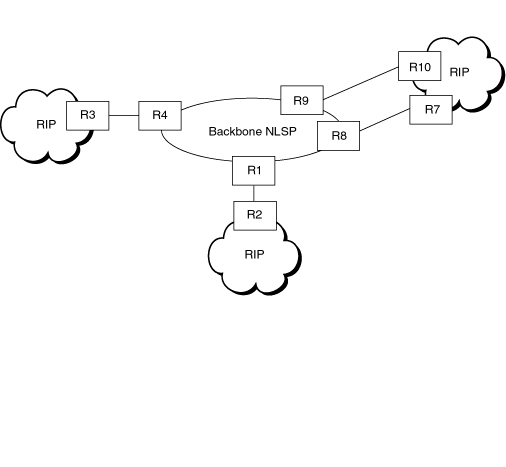
Figure 1-14 shows a typical topology for using route aggregation, a backbone network with several RIP areas attached. In Figure 1-14, the information within the backbone is minimized by having routers R1, R4, R8, and R9 report address summaries for the attached areas. In this scenario, the default route is the only information about reachable external addresses that must be transmitted within an attached area. Therefore, information within the attached areas is minimized.
Figure 1-14.
Aggregated Routes Topology
Aggregated routes are introduced into NLSP in the same way that external RIP routes are introduced. There are two methods of introducing aggregated routes into NLSP:
For example, if a router is configured with address summaries 572* and 5729* on a link running RIP and learns from that link that the destination 57285489 is reachable and that no other matching destinations are learned, then the router reports the aggregated route 572* to the NLSP area. The asterisk represents a wildcard character. If the router learns that destination 57298381 is reachable, then only 5729* is reported to the NLSP area. If both 57298381 and 57212376 are reachable, then the router reports both 572* and 5729* to the NLSP area.
Routers always report aggregated routes with the longest match. For example, if a router is configured with address summaries C9* and C91* and learns that the destination C9123456 is reachable, then the router reports only the aggregated route C91*.
Route aggregation into an NLSP area is possible only if all routers in that area support address summaries. Routers that do not support route aggregation do not recognize destination addresses for aggregated routes; they forward packets to the default route or drop packets if no default route is configured. Because routers that support route aggregation route packets differently from routers that do not support route aggregation, routing loops can occur. Therefore, if a router that supports route aggregation detects that the next-hop router on the path to an aggregated destination is a router that does not support route aggregation, it will drop the packet.
Without route aggregation, if a service is announced with an address that is not explicitly reachable, RIP assumes the service is unreachable. When NLSP and RIP are used with route aggregation, SAP is accepted, provided a packet can be forwarded to the corresponding network number. A packet can be forwarded when there is a default route and address summary or when there is an explicit advertisement of that network number.
This feature is disabled by default. It can be enabled by entering the following command after IPXRTR.NLM has been loaded:
SET REQUIRED NETWORK FOR SERVICES=ON
If a router is configured to introduce an address summary into an NLSP area, it does so, with the number of ticks equal to 1 (as the default), an area count equal to 6 (as the default), and the ability to configure both parameters with a different value. The area count is the number of areas through which the route information is allowed to propagate. As the route information is passed through each of these areas, the area count is decremented by one. This enables the initial sending router to control the spread of information through all NLSP areas that are connected to each other.
Address summaries are not exported from an NLSP area into a RIP cloud because the capability to express a summarized route within RIP does not exist. In addition, updating RIP with this capability is not cost-effective because the default route is sufficient for RIP.