NetWare Link/X.25 Architecture
NetWare Link/X.25 implements the X.25 standard, which spans the bottom three layers in the OSI reference model for networking. Figure 9-2 represents the standard OSI layers and the corresponding X.25 layers.
Figure 9-2.
OSI and X.25 layers
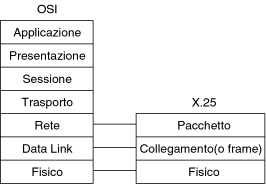
Table 9-1 lists the X.25 layers and provides their corresponding descriptions and protocols.
Table 9-1. X.25 Architecture
OSI X.25 Layer |
Function |
Protocol |
|---|
Packet |
Multiplexing (relay, routing, and switching) |
X.25 Packet Layer Protocol |
Link (or Frame) |
Point-to-point synchronization, error detection and correction, and flow control |
HDLC and LAPB |
Physical |
Bit transmission and media interface |
X.21 bis in the U.S. X.21 in Europe |
NetWare Link/X.25 consists of the following three layers:
- Packet---Corresponds to the Network layer in the OSI model. The most important feature of this layer is multiplexing. It controls call setup and clearing, packet transfer, and network facility selection. The Packet layer specifies the virtual circuit service for both switched virtual circuits (SVCs) and permanent virtual circuits (PVCs). It conforms to the ITU-T X.25 Packet-layer specification.
- Link---Transports data across the physical link, controls the interchange between the DTE and the DCE, and corrects any link errors. This is a subset of the ISO standard High-level Data Link Control (HDLC) protocol, known as Link Access Procedure-Balanced (LAPB). It conforms to the ITU-T X.25 Link-layer specification, except for the multilink procedure.
- Physical---Defines the physical interface between a DTE and DCE (the X.21 and X.21 bis specifications for physical attachment to the packet network). Recommendations include voltages, signaling, plug types, and pin connections.
NetWare Link/X.25 Components
Figure 9-3 shows the components of NetWare Link/X.25.
Figure 9-3.
NetWare Link/X.25 Components
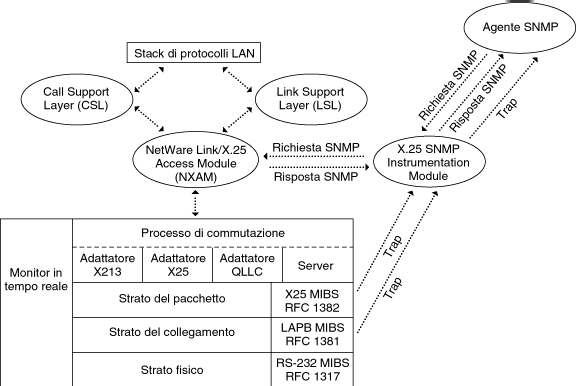
The following components make up NetWare Link/X.25:
- Call Support Layer (CSL) software---Provides the interface for call controls to establish, maintain, and disconnect a connection. The CSL also maintains the configuration and target databases.
- Link Support LayerTM (LSLTM) software---Provides a general user interface between LAN, WAN, and Open Data-Link InterfaceTM (ODITM) component modules for data transfer.
- NetWare SNMP Agent---Provides access to management data about a particular network device or application and responds to the inquiries received from the SNMP management station. The NetWare SNMP Agent also transmits the traps to the destinations specified in the TRAPTARG.CFG file.
- X.25 SNMP Instrumentation Module---Processes the incoming SNMP inquiries, accesses the X.25 MIB and LAPB MIB, and responds to the SNMP inquiries. The module also generates the various traps upon detection of significant NetWare Link/X.25 events.
- X.25 MIB (RFC 1382)---Management Information Base (MIB) implemented for the NetWare Link/X.25 Packet layer to support SNMP.
- LAPB MIB (RFC 1381)---MIB implemented for the NetWare Link/X.25 Link layer (LAPB) to support SNMP.
- RS-232 MIB (RFC 1319)---MIB implemented for the NetWare Link/X.25 Physical layer to support SNMP.
- NetWare Link/X.25 Access Method (NXAM)---Implements Call Control Agent (CCA) functions to provide an interface with the CSL for X.25 connection management, and an ODI interface with the LSL for X.25 data transfer.
- Real-Time Monitor---Controls the tasks implemented within X.25: the Switch process, the Packet layer, and the Link layer.
- Switch process---Manages the queues used to communicate between the X.25 software and the NXAM software.
- X.25 Adapter---Provides users with the standard X.25 interface.
- X213 Adapter---Provides users with the ITU-T X.213 Network Service interface.
- QLLC Adapter---Selected by the user to transmit or receive SNA data traffic over the X.25 data link.
- Server---Controls the virtual circuit and handles all incoming calls.
The Packet, Link, and Physical layers are described in the following sections.