IP Datagram Encapsulation
Each physical medium has its own physical address for nodes on that medium. The physical addresses are also called MAC addresses. Ethernet and token ring networks use 6-byte MAC addresses. ARCnet uses a 1-byte MAC address.
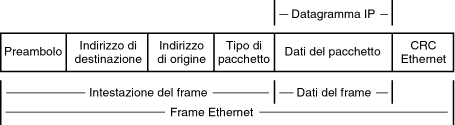
IP addresses are independent of the hardware. When an IP packet is transmitted on the network, it is first encapsulated within the physical frame used by that network. Figure 2-8 shows an IP packet encapsulated in an Ethernet frame. The IP packet contains an Internet address for a node, but the Ethernet frame must have a physical address for it to be delivered on the data-link network. Therefore, the sending node must be able to map an IP address to a physical hardware address.
Figure 2-8.
IP Datagram Encapsulation
When an IP address is mapped to a physical, or MAC, address, ARP is used on broadcast networks such as Ethernet, token ring, and ARCnet. When a node uses IP to send a packet, it must determine which physical address on the network corresponds to the destination IP address. To find the physical address, the node broadcasts an ARP packet containing the destination IP address. The node with the specified destination IP address sends its physical address back to the requesting node.
To speed packet transmissions and reduce the number of broadcast requests that must be examined by every node on the network, each node keeps an address resolution cache, or ARP table. Each time the node broadcasts an ARP request and receives a response, it creates an entry in its address resolution cache. The entry maps the IP address to the physical address.
When the node sends an IP packet, it looks up the IP address in its cache and uses the physical address, if found. The node broadcasts an ARP request only if the IP address is not in its cache.