Protocol Architectural Model
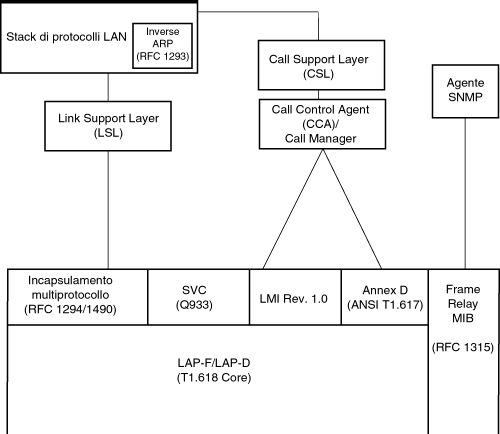
The NetWare Link/Frame Relay software enables the router to send data frames through the frame relay network. Figure 8-3 shows the NetWare Link/Frame Relay protocol architectural model.
Figure 8-3.
Protocol Architectural Model
Note that the SVC service is not currently implemented.
Table 8-2 explains each module in the architecture.
Module |
Description |
|---|---|
LAN Protocol Stacks |
The LAN protocols supported with this release of NetWare Link/Frame Relay include IPX, AppleTalk, TCP/IP, and source route bridge. |
Link Support Layer (LSL) |
An implementation of the Open Data-Link Interface (ODI) specification, the Link Support LayerTM (LSLTM) software serves as an intermediary between the server/router LAN drivers and the communication protocol, such as IPX, TCP/IP, and AppleTalk. LSL allows one network board to service several communication protocol stacks. |
Inverse ARP |
Determines the Network-layer address from the specific DLCI. |
Multiprotocol Encapsulation |
An encapsulation method, based on RFC 1490, of higher-level Protocol Data Units (PDUs) that allows multiplexing of multiprotocol LAN traffic over a single frame relay link, so that receiving nodes can interpret and demultiplex the PDUs properly. |
Call Support Layer (CSL) |
The call processing coordination between NetWare Link/Frame Relay and the higher-level protocol stack. The configuration and target databases specify connection requests. The CSL target database maintains a directory of remote network/router destinations for each configured WAN media type. The CSL configuration database maintains all configuration information on the specific aspects of each type of transport media. Each target database entry contains the media-specific information needed to establish a call using a specific media type to one remote system. |
Call Control Agent (CCA) |
Works in tandem with the CSL; the CCA contains WAN media-specific connection management logic. |
SVC |
The switched virtual circuit (SVC) is not implemented in this release. |
LMI Rev. 1.0 |
The Local Management Interface (LMI) is an implementation agreement that addresses signaling and other network management functions. |
Annex D |
An implementation standard (ANSI T1.617) that addresses signaling and other network management functions. |
SNMP Agent |
Initiates and responds to requests for management information. |
Frame Relay MIB |
A Management Information Base (MIB) implemented for NetWare Link/Frame Relay to allow it to support SNMP. |
LAP-F/LAP-D |
T1.618 core protocols used as the basis for the NetWare Link/Frame Relay software. |
Figure 8-4 shows the general NetWare Link/Frame Relay data frame format.
Figure 8-4.
Data Frame Format
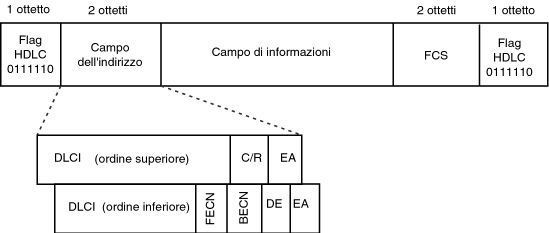
The High-level Data Link Control (HDLC) flags are the first and last octet, and indicate the beginning and end of the frame. If there is only one flag between two consecutive frames, the closing flag of the first frame serves as the opening flag of the next frame.
The Address field consists of the NetWare Link/Frame Relay control and management fields. These fields specify the virtual circuit numbering, flow control, and frame discard eligibility.
The Data Link Connection Identifier (DLCI) is a 10-bit routing address. The DLCI consists of two noncontiguous bit fields in the header, the most significant bit (MSB) or high order bit field and the least significant bit (LSB) or low order bit field. The DLCI is the address of the virtual circuit at either the User-Network Interface (UNI) or the Network-Network Interface (NNI). It allows the user and network management to identify the frame as being from a particular PVC. The DLCI is used for multiplexing several PVCs over one physical link. The router DLCI specifies a local virtual circuit.
For both ANSI T1.618 and the LMI standards, the DLCI addressing space allows 1,024 values at each local interface. Because some DLCIs are used for signaling, management, and future specification, 992 of 1,024 DLCIs (16 through 1,007) are available to address frame relay virtual circuits at each local interface, as shown in Table 8-3 and Table 8-4.
DLCI Number |
ANSI T1.618 Specification |
|---|---|
0 |
In-channel signaling |
1 to 15 |
Reserved |
16 to 991 |
Assigned using frame relay connection procedures |
992 to 1,007 |
Layer 2 management |
1,008 to 1,022 |
Reserved |
1,023 |
In-channel layer management |
DLCI Number |
LMI Rev 1.0 Specification |
|---|---|
0 |
Reserved for call control signaling (in-channel) |
1 to 15 |
Reserved |
16 to 991 |
Assigned using frame relay connection procedures |
992 to 1,007 |
Assignable to frame relay PVCs |
1,008 to 1,022 |
Reserved |
1,023 |
Local management of interface |
The Command/Response (C/R) is not used in this industry-standard implementation. It is always set to 0.
By enabling the NetWare Link/Frame Relay header to extend to either 3 or 4 octets, the Extended Address (EA) allows for a DLCI longer than 10 bits and greatly expands the number of possible addresses.
Forward Explicit Congestion Notification (FECN) is set by the frame relay network to indicate that it has experienced congestion in the packet forwarding direction of the frame.
When this bit is set to 1, the frame relay network notifies the user receiving the frames that congestion is occurring in the direction in which the frame is being sent.
Backward Explicit Congestion Notification (BECN) is set by the frame relay network to indicate that the network has experienced congestion in the reversed packet forwarding direction of the frame.
When this bit is set to 1, the frame relay network notifies the user sending the frames that congestion is occurring in the direction opposite to that in which the frame is being sent.
The Discard Eligibility (DE) bit is set by the end node and, when set and supported by the frame relay network, allows frames to be discarded in preference to other frames when a network is congested.
The frame relay network edge node might discard transmitted data exceeding the Committed Information Rate (CIR) on a PVC. (The CIR is the data rate at which the frame relay network agrees to transfer data.) Internally, the frame relay network might prefer to discard data with the DE set when it encounters congestion. If the congestion condition persists after discarding all frames with the DE set, the congested node can start discarding frames with the DE cleared.
Network edge nodes can also set DE bits in response to user data that exceeds the committed burst size during a fixed measured interval.
The Information field (also called the Data field) contains the protocol data packet being transmitted. The field can contain a maximum of 4,520 octets; however, the 16-bit Frame Check Sequence (FCS) is more effective with frames smaller than 4K. You should ensure that the network can handle the maximum frame size sent by the router. If not, you must adjust the Maximum Frame Size parameter in NIASCFG.
Different network and frame relay switches are expected to support varying sizes. However, the maximum size of 4,520 octets should accommodate most LAN traffic and frame relay network variations. The maximum information field size is configurable on a per-port basis. To avoid or minimize segmentation and reassembly of higher-level PDUs, you should choose an optimal frame size.
Novell supports the multiprotocol encapsulation scheme described in RFC 1490 to multiplex multiprotocol LAN traffic over a single frame relay link. This means that higher-level PDUs must be encapsulated so that receiving nodes can interpret and demultiplex them properly.
The Frame Check Sequence (FCS) is the standard 16-bit cyclic redundancy check (CRC) used by HDLC. This field detects bit errors that occur in the bits of the frame between the opening flag and the FCS. The WAN board performs a 16-bit CRC to ensure data integrity.
Private line networks permanently allocate dedicated transmission resources between communication end points, regardless of the traffic conditions. Because the frame relay network uses statistical multiplexing, the transmission resources are not allocated until there are active communications. Network resources are shared dynamically among participating end points.
Frame relay networks provide the best features of time-division multiplexing (TDM) high-speed, low-delay circuit switching and the statistical multiplexing and port sharing of X.25 packet-switching technologies. These features guarantee bandwidth according to the set CIR, and allow bandwidth-on-demand bursts, when available.
The frame relay network consists of frame relay switches, which usually are owned and administered by the carriers. The access connection to the frame relay network is typically provided by a Local Exchange Carrier (LEC); it can also be bundled into the frame relay provider's service. The network provider can be an LEC; a metropolitan frame relay service; an Interexchange Carrier (IXC); or an interstate, national, or global frame relay service.
NetWare Link/Frame Relay encapsulates data frames and routes them through the frame relay network based on the DLCI, which identifies the local PVC end point of the router. DLCIs are configured through the configuration process or learned through the NetWare Link/Frame Relay link management protocol.
A frame relay network has the following characteristics:
With NetWare Link/Frame Relay, you can have a logical end-to-end link (a virtual private line) between communication end points. Although NetWare Link/Frame Relay appears as a dedicated private network to the user, the use of virtual circuits and high-speed internode trunking make the NetWare Link/Frame Relay service more cost-effective than a dedicated line service, with similar performance. NetWare Link/Frame Relay is intended primarily for high-speed, bursty data communications applications, such as LAN interconnections.
The UNI and NNI standards define the interoperability between end points on the LAN and the end points of the frame relay network, and between frame relay networks. This is shown in Figure 8-5.
Figure 8-5.
Interoperability Standards

UNI describes how a router connects and accesses frame relay network services.
NNI describes how frame relay networks interconnect. With NNI, users subscribing to different frame relay network providers can communicate. Note that the standards for NNI have been defined only recently, and few network providers and equipment manufacturers currently support NNI.