1.0 Overview of ConsoleOne
Novell® ConsoleOne™ provides a Java-based foundation for graphical utilities that manage and administer network resources from different locations and platforms. ConsoleOne provides a single point of control for all Novell and external products.
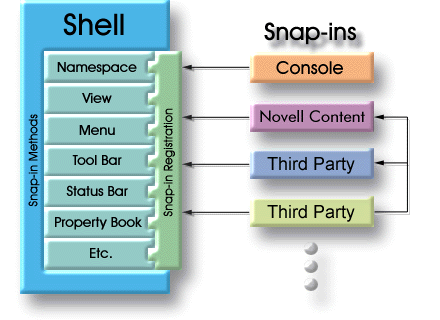
ConsoleOne consists of a shell for managing applications and resources. Included with the shell are an extensible snap-in framework and programming interfaces (APIs) that developers can use to create snap-ins for managing specific resources. The shell itself offers no management functionality. Snap-ins (commonly referred to as content) extend the shell by snapping into the framework and providing the actual management functionality. All content is registered to ConsoleOne as a snap-in by implementing one of a rich set of interfaces, and then by placing the snap-in into the appropriate directory.
In addition to the shell, Novell provides a default console snap-in that specifies conventions for menu item placement and a standard set of toolbar and menu bar items. Developers must use these conventions to build their snap-in content. Novell has published its set of content, along with instructions for extending that content through specific snap-in registration. Third-party developers may also provide content and publish their own set of snap-in registration points.
Because the shell and console snap-ins are completely implemented in Java, ConsoleOne can run on any system that has a Java Virtual Machine (JVM), making it platform independent.
The ConsoleOne snap-in architecture is summarized in the figure below.
Figure 1-1 The ConsoleOne Snap-in Architecture
The links below provide access to the major sections of the Novell ConsoleOne SDK documentation. To obtain a more current version of the ConsoleOne SDK documentation you can access the Novell Developer Kit web site.