

| |
Private line networks permanently allocate dedicated transmission resources between communication end points, regardless of the traffic conditions. Because the frame relay network uses statistical multiplexing, the transmission resources are not allocated until there are active communications. Network resources are shared dynamically among participating end points.
Frame relay networks provide the best features of time-division multiplexing (TDM) high-speed, low-delay circuit switching and the statistical multiplexing and port sharing of X.25 packet-switching technologies. These features guarantee bandwidth according to the set CIR, and allow bandwidth-on-demand bursts, when available.
The frame relay network consists of frame relay switches, which usually are owned and administered by the carriers. The access connection to the frame relay network is typically provided by a Local Exchange Carrier (LEC); it can also be bundled into the frame relay provider's service. The network provider can be an LEC; a metropolitan frame relay service; an Interexchange Carrier (IXC); or an interstate, national, or global frame relay service.
NetWare Link/Frame Relay encapsulates data frames and routes them through the frame relay network based on the DLCI, which identifies the local PVC end point of the router. DLCIs are configured through the configuration process or learned through the NetWare Link/Frame Relay link management protocol.
A frame relay network has the following characteristics:
With NetWare Link/Frame Relay, you can have a logical end-to-end link (a virtual private line) between communication end points. Although NetWare Link/Frame Relay appears as a dedicated private network to the user, the use of virtual circuits and high-speed internode trunking make the NetWare Link/Frame Relay service more cost-effective than a dedicated line service, with similar performance. NetWare Link/Frame Relay is intended primarily for high-speed, bursty data communications applications, such as LAN interconnections.
The UNI and NNI standards define the interoperability between end points on the LAN and the end points of the frame relay network, and between frame relay networks. This is shown in Figure 5.
Figure 5
Interoperability Standards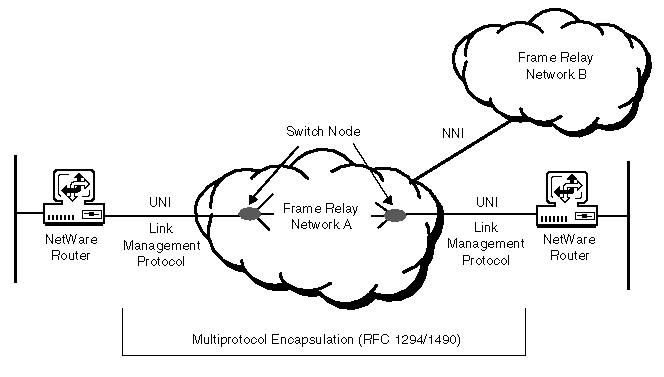
UNI describes how a router connects and accesses frame relay network services.
NNI describes how frame relay networks interconnect. With NNI, users subscribing to different frame relay network providers can communicate. Note that the standards for NNI have been defined only recently, and few network providers and equipment manufacturers currently support NNI.
| |