

| |
NetWare Link/PPP supports connections over ISDN lines. ISDN is a digital network technology being deployed by international and domestic service providers to replace outdated analog technology. ISDN service is already widely available in Europe and the Pacific Rim, and is becoming widely available in the United States.
Collectively, ISDN is a set of digital transmission protocols defined by the ITU. ISDN provides both voice and data services over two types of lines: a Basic Rate Interface (BRI) and a Primary Rate Interface (PRI). Each type of line consists of a number of 64-Kbps bearer channels (or B channels) and one 16-Kbps or 64-Kbps delta channel (or D channel). B channels are clear-channel connections that can be used for voice and data communication. The D channel is used for signaling and X.25 packet networking.
A BRI line contains two 64-Kbps B channels and one 16-Kbps D channel. In some telco networks, inbound signaling is done by a technique known as bit robbing, and the B channel rate adapts down to 56 Kbps for interoffice traffic. Figure 2 illustrates a BRI line.
Figure 2
ISDN BRI Line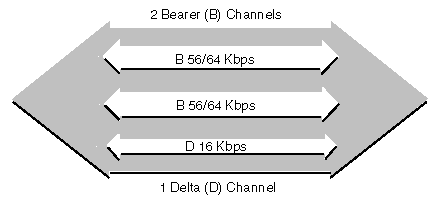
A PRI line in North America and Japan contains 23 64-Kbps B channels and one 64-Kbps D channel. It has a total bandwidth of 1.544 Mbps and is designed for transmission through a standard North American T-1 trunk. (In other locations, the PRI line contains either thirty or thirty-one 64-Kbps B channels and one 64-Kbps D channel.)
PPP over ISDN offers inexpensive and reliable WAN connectivity. Dial-up ISDN connectivity is significantly less expensive than leased synchronous lines. In addition, communication over ISDN lines is faster and more accurate than that attainable over analog telephone lines using modems for digital-analog conversion.
| |