

| |
NetWare Link/PPP on-demand WAN connections are established at the request of network protocols, based on the presence of user data that must be routed to a destination across the connection. If no data is flowing across an on-demand WAN connection for a preset configurable period of time, then the connection is terminated.
On-demand WAN connections are similar to the way a telephone is used. An outbound call to a remote party is placed by dialing the phone number, and a connection is made when the remote party picks up the phone. A conversation takes place and terminates when one of the parties hangs up the receiver. When a telephone is not in use, it is available to place other outbound calls or accept inbound calls from remote parties. The costs for using the telephone are based on the duration and distance of each call.
Figure 1 illustrates on-demand WAN connections between offices. When Branch 1 has data to send to the Main Office, it uses on-demand call 1, named Call_Main_Office . After the router transfers the data and the link reaches the idle link timeout, the call is disconnected. When Branch 2 has data to send to Branch 1, it uses on-demand call 2, named Call_Branch_1 .
Figure 1
On-Demand Connections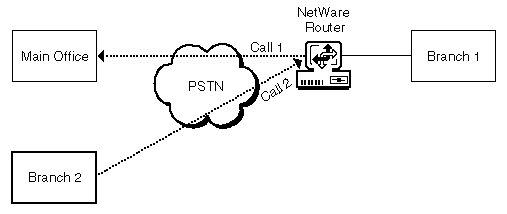
The analogy between NetWare Link/PPP on-demand connections and telephone calls is not superficial. Voice-grade telephone lines can be used to establish low-bandwidth (typically 2,400 bps to 28,800 bps) on-demand connections. ISDN lines can be used to establish medium-bandwidth (56/64 Kbps to 112/128 Kbps) on-demand connections. Depending on bandwidth requirements, on-demand connections placed over PSTNs (Public Switched Telephone Networks) can be a simple and quick way to establish temporary connectivity between remote LANs.
If low-bandwidth connections do not suffice, you can consider a switched data service, such as switched/56 or switched/256. Switched services can offer significant cost savings over dedicated circuits with the same bandwidth.
Synchronous interfaces operating over ISDN lines are excellent for on-demand connections because they provide 5 to 10 times the bandwidth of analog connections at significantly lower error rates.
On-demand connections have the following advantages:
Cost ---On-demand connections terminate when there is no data to route across the connection. This means that you pay only for the time the connection is in use, not for idle time, as in the case of a permanent WAN connection.
Flexibility ---You might initially use a single interface to establish an on-demand call to a remote LAN. After the connection terminates, you can use the same interface to establish another on-demand connection to a different remote LAN. Unlike permanent WAN connections, no service provider involvement is necessary to connect to a different destination.
| |