NetWare/
IP Domain
NetWare/IP uses DNS for two purposes:
NetWare/IP does not require that the DNS service be resident on a NetWare platform. If you are already using DNS on your network, you can continue to use the existing DNS name server. However, the NetWare DNS service provides all the functionality of a standard DNS service without the configuration and management complexities. The NetWare DNS service is fully compatible with Berkeley Internet Name Domain (BIND 4.8.3). Using the DNS administration utility, UNICON, you can accomplish all NetWare DNS tasks by choosing options from a series of menus rather than editing configuration files.
Although the NetWare DNS service offers full DNS support, NetWare/IP uses only a small portion of the DNS capability. The following sections describe how NetWare/IP uses DNS.
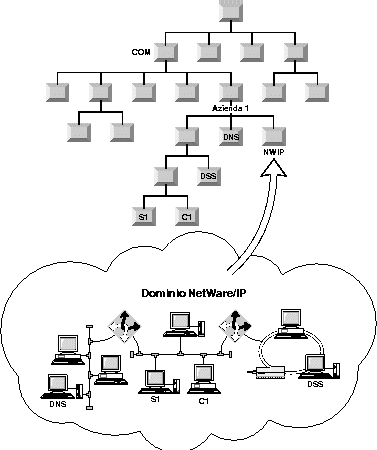
To set up a NetWare/IP network, you must create and delegate a special DNS domain called the NetWare/IP domain. This domain is created in the same way as any other domain and, once created, appears in the DNS hierarchy just like any other domain.
However, the NetWare/IP domain is different from a standard DNS domain in that it always resides at the bottom of the DNS hierarchy with no subdomains or hosts. Instead, the hosts that make up the domain are distributed throughout the DNS hierarchy. The function of the NetWare/IP domain is to unite these distributed hosts into a logical network. Thus, even though the hosts are scattered throughout the domain name space, they are administered as a single logical network. All NetWare/IP nodes that belong to the same NetWare/IP domain are serviced by a single primary DSS server. Thus, the NetWare/IP domain also acts as a boundary for SAP and RIP information.
For example, suppose company1 decides to set up a NetWare/IP network. The administrator creates a NetWare/IP domain, nwip.company1.com., below the company1.com. domain. The company1 administrator then installs the NetWare/IP software on servers and clients that are distributed throughout the company1.com. zone and configures them as part of the DNS domain as well as the NetWare/IP domain, as shown in Figure 2-8 .
Figure 2-8.
NetWare/
IP Domain
NetWare/IP uses two different types of name servers:
NetWare/IP uses a standard DNS name server to obtain information about the location of the DSS servers for the NetWare/IP domain. To do this, NetWare/IP requires a standard DNS name server in the parent domain of the NetWare/IP domain. The DNS name server must be modified to recognize the DSS servers as name servers for the NetWare/IP domain.
If DNS is already in use in the network, you can simply add an NS record for each DSS server in the NetWare/IP domain. If DNS is not already in use on the network, you must set up a DNS server and add NS and A records for each DSS server for the NetWare/IP domain and an SOA record for the DNS domain.
NOTE: These are the only resource records required for NetWare/IP. NetWare/IP uses only a limited DNS service. Additional resource records would have to be added for the server to function as a standard DNS server within the domain name space.
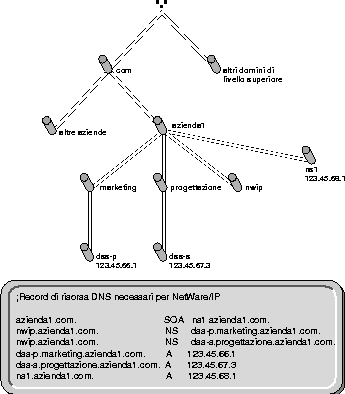
For example, suppose company1 has two DSS servers, DSS-P and DSS-S, servicing its NetWare/IP domain, nwip.company1.com. The administrator must set up a DNS server in the company1.com. domain. The administrator must also add NS and A records for DSS-P and DSS-S and an SOA record for the company1.com. domain. This example is illustrated in Figure 2-9 .
If company1 wants to connect to the Internet or to other TCP/IP networks, the DNS database must also be populated with appropriate A records for all hosts in the zone and linked to the existing DNS hierarchy.
Figure 2-9.
DNS Resource Records Required for NetWare/
IP
Each NetWare/IP server and client maintains information about the DNS and NetWare/IP domains in which it is administered and up to three DNS name servers it can contact. Then, when a system starts up, it queries each known DNS name server for the addresses of the available DSS servers for its NetWare/IP domain.
DSS servers within the NetWare/IP network provide the second level of DNS name services. DSS servers are identified as name servers for the NetWare/IP domain. However, these name servers do not provide the standard name-to-address mapping services. Instead, they maintain information about the availability of services and routes in the network and distribute this information to NetWare/IP hosts as needed.
For more information on the purpose and function of DSS servers, see Understanding the Domain SAP/RIP Service