Planning Your X.25 Network
To ensure that all aspects of your planned connections to the X.25 network are covered, complete the following steps:
- For each location that a router attaches to the X.25 network, specify the following parameters:
- Physical interface required (for example, V.35 or RS-232)
- Internal interface speed required (for example, 9,600 or 19,200)
This value is required only when the clocking is generated internally. Otherwise, clocking comes from the modem.
- Number of partner routers that will be connected using X.25
- For each partner, whether a PVC or an SVC is required
- Packet size required (for example, 128 bytes or 256 bytes)
- Using the information from Step 1, fill in the NetWare Link/X.25 Network Access Worksheet.
Figure 8 shows the NetWare Link/X.25 Network Access Worksheet.
The NetWare Link/X.25 Network Access Worksheet fields are described following the worksheet.
- Contact your X.25 network service provider and request the specific parameter values you require.
These values correspond to those specified on the worksheet.
The X.25 network service provider will set up your service and assign a range of virtual circuit numbers to meet your requirements.
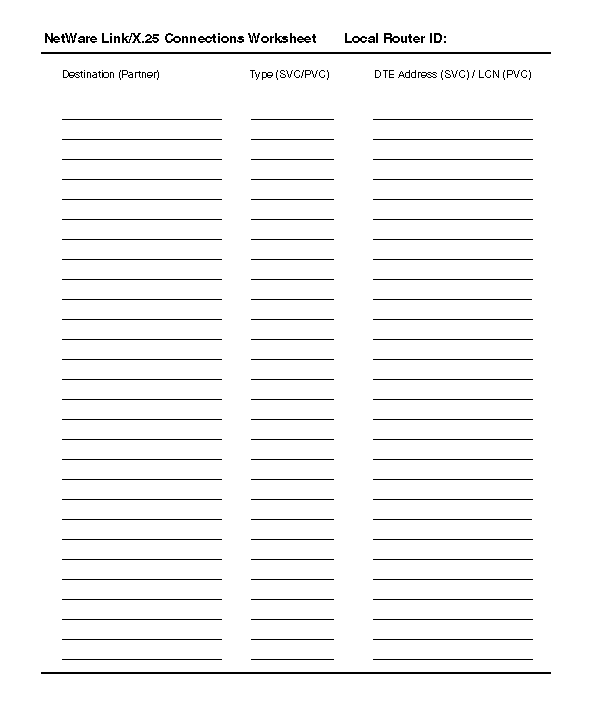
- Using the information from Step 3, fill in the NetWare Link/X.25 Connections Worksheet.
Figure 9 shows the NetWare Link/X.25 Connections Worksheet.
Figure 8
NetWare Link/X.25 Network Access Worksheet
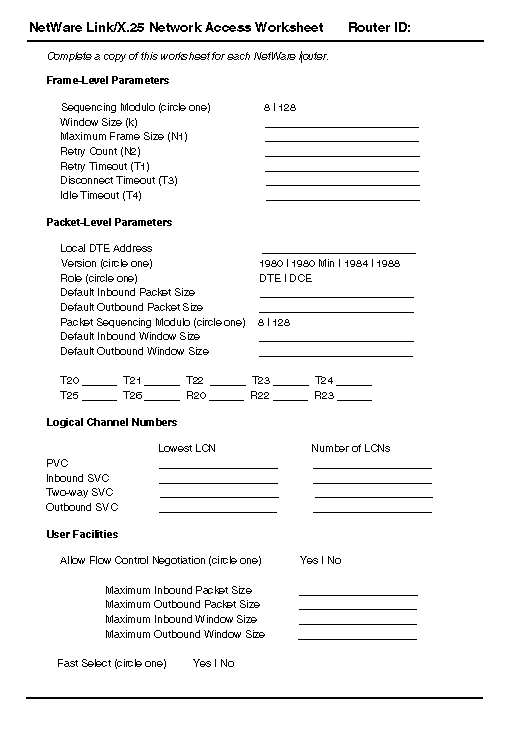
The following list describes the fields in the NetWare Link/X.25 Network Access Worksheet:
NetWare Link/X.25 Router ID (at top of page)---Symbolic name assigned by the system administrator to identify a particular NetWare Link/X.25 router. The ID provides a way to track or reference a particular NetWare Link/X.25 router.
This topic contains the following sections:
Frame-Level Parameters
- Sequencing Modulo ---Specifies the numbering of sequential frames allowed in a Data-Link layer window. For most networks, Modulo 8 should be used. For special networks, Modulo 128 can be used; this allows users to select a larger window size.
NOTE: The Default Window Size field is dependent on which Modulo method you select here.
- Window Size (k) ---Determines the maximum number of sequential frames that can be received or sent before the server or router sends (or waits for) an acknowledgment.
- Maximum Frame Size (N1) ---Determines the maximum frame size allowed to be received on the link (in octets).
- Retry Count (N2) ---Determines the maximum number of times a frame should be retransmitted because of the expiration of the Retry Timer (T1). A large value for this parameter increases the probability of a correct transfer between the DTE and DCE. A small value permits faster detection of a permanent error condition.
- Retry Timeout (T1) ---Determines the time, in seconds, to wait for an acknowledgment of the oldest transmitted frame. If no acknowledgment is received within this set time, an attempt is made to determine the status of the remote device.
Set this parameter to a value slightly greater than twice the transmission time of the longest frame, including anticipated delay time to the peer node.
- Disconnect Timeout (T3) ---Displays the value of the T3 timer. After attempting to connect the link by sending N2 Set Asynchronous Balanced Mode (SABM) frames on T1 expiration, the Data-Link layer continues sending SABM frames when the T3 timer expires.
- Idle Timeout (T4) ---Specifies the amount of time the local DTE waits (when a link becomes idle) before attempting to poll the partner node for status. If the partner node does not respond to the polls, the link is reset and all current virtual calls are cleared or reset.
Packet-Level Parameters
- Local DTE Address ---Specifies the X.121 address (up to 15 digits) of the local DTE. It should match the address assigned by your attached network. This address in included in the Calling Address field of the outbound Call Request packets.
- Version ---Determines the specific conformance year for the X.25 specification you use for this port.
- Role ---Determines whether you use DTE or DCE procedures for packet-level operation in the logical channel number (LCN) assignment.
When establishing a connection to an X.25 network, you must set this parameter to DTE (the default value) to avoid call collisions.
- Default Inbound Packet Size ---Determines the default packet size that is used for a call. Unless another packet size is specified when the call is made, the default packet size value is used. Set this value to correspond to your network subscription.
- Default Outbound Packet Size ---Determines the maximum outgoing data packet size when a call is established without the Flow Control Negotiation parameter. The Default Outbound Packet Size should be a value that is agreed on by the PDN and the remote DTE.
- Sequencing Modulo ---Provides control over the numbering of sequential data packets allowed in a window. For most networks, Modulo 8 should be used.
NOTE: The Default Window Size field is dependent on which Modulo method you select here.
- Default Inbound Window Size ---Specifies the default number of sequential incoming or outgoing data packets that can be sent before an acknowledgment is required.
NOTE: The Packet Sequencing Modulo and Window Size fields are independent of the Frame Sequencing Modulo and Window Size parameters.
- Default Outbound Window Size ---Specifies the default value of the maximum number of sequentially numbered data packets that can be transmitted by the local DTE without receiving an acknowledgment at any given time.
When a virtual circuit is established without flow control negotiation, this value is used as an outbound window size. You should set this parameter to the value agreed on by the PDN.
- T20 (Restart Response Timer) ---Determines the amount of time, in seconds, that the local DTE waits when it issues a Restart Request packet to receive a restart confirmation or restart indication.
When the time limit expires, the Restart Request packet is retransmitted.
- T21 (Call Response Timer) ---Specifies the amount of time, in seconds, that the DTE waits for a response to an outbound Call Request packet.
- T22 (Reset Response Timer) ---Specifies the amount of time, in seconds, that the DTE waits for a response to a Reset Request packet.
- T23 (Clear Response Timer) ---Specifies the amount of time, in seconds, that the DTE waits for a response to a Clear Request packet.
- T24 (Ack-Send Timer) ---Specifies the amount of time, in seconds, that a DTE waits when a packet carrying a valid acknowledgment is sent.
This timer is used to ensure that no acknowledgment is lost. If the timer expires, an RR (Receiver Ready) packet is sent.
- T25 (Data Packet Retransmission Timer) ---Specifies the amount of time, in seconds, that the DTE waits for the appropriate acknowledgment after transmitting a data packet.
If the T25 timer expires, the packet layer resets the virtual circuit.
- T26 (Interrupt Timer) ---Specifies the amount of time, in seconds, that the DTE waits when an Interrupt Request packet is sent for an interrupt confirmation to be received.
If the T26 timer expires, the packet layer resets the virtual circuit.
- R20 (Restart Retransmission Timer) ---Specifies the maximum number of times the local DTE retransmits, upon expiration of the T20 timer, before notifying the user that the associated link is inoperative.
- R22 (Restart Retransmission Count) ---Determines the maximum number of times the local DTE retransmits a Reset Request packet, upon expiration of the T22 timer, before initiating a Clear procedure for SVC or a Restart procedure for PVC.
- R23 (Clear Retransmission Count) ---Determines the maximum number of times the local DTE retransmits a Clear Request packet, upon expiration of the T23 timer, before initiating a Restart procedure on the associated link.
Logical Channel Numbers
- PVC, Lowest LCN ---Determines the lowest LCN that can be used for a PVC.
- PVC, Number of LCNs ---Determines the number of logical channels supporting PVCs.
This number must agree with your network subscription.
- Inbound SVC, Lowest LCN ---Determines the lowest LCN that can be used for one-way incoming logical channels for SVCs.
This value must be greater than or equal to the Lowest PVC LCN parameter value.
- Inbound SVC, Number of LCNs ---Determines the number of incoming channels assigned for inbound-only SVCs.
This number must agree with your network subscription.
- Two-Way SVC, Lowest LCN ---Determines the lowest number of two-way channels assigned for SVCs that can be used for both inbound and outbound calls.
- Two-Way SVC, Number of LCNs ---Determines the lowest LCN that can be used for two-way SVCs.
This number must agree with your network subscription.
- Outbound, Lowest LCN ---Determines the lowest LCN that can be used for outgoing logical channels for SVCs.
The value must be greater than or equal to the Lowest Two-Way SVC LCNs value plus the Number of Two-Way LCNs value.
- Outbound, Number of LCNs ---Determines the number of logical channels reserved for outbound-only SVCs.
This number must agree with your network subscription.
User Facilities
- Allow Flow Control Negotiation ---If set to Yes, negotiates (downgrades) incoming calls containing either Window Size or Packet Size facility values that are greater than those specified.
If set to No, rejects incoming calls containing either Window Size or Packet Size facility values that are greater than those specified.
- Maximum Inbound Packet Size ---Specifies the largest incoming packet size that can be negotiated on a per-virtual-circuit basis.
- Maximum Outbound Packet Size ---Specifies the largest outgoing packet size that can be negotiated on a per-virtual-circuit basis.
- Maximum Inbound Window Size ---Specifies the largest value, per virtual circuit, to be negotiated in a Window Size facility parameter field.
The maximum value for this parameter is dependent on which Packet Sequencing Modulo method you selected.
- Maximum Outbound Window Size ---Specifies the largest value, per virtual circuit, to be negotiated in a Window Size facility parameter field.
The maximum value for this parameter is dependent on which Packet Sequencing Modulo method you selected.
- Fast Select ---If set to Yes, allows up to 128 bytes of user data to be included in Call Request packets. If set to No, user data is not included in Call Request packets.
Figure 9
NetWare Link/X.25 Connections Worksheet
| |
  |
|