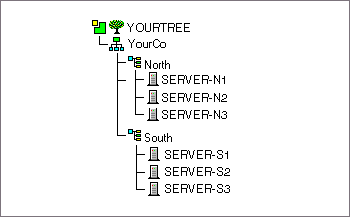
Slow or unreliable WAN links affect your NDS tree design. You should create containers for each site separated by such links, placing each NetWare Server object in its local container.
The advantage of this level of site containers is partitioning. Objects representing local resources can be kept on a local partition, eliminating synchronization traffic over the WAN.
Another benefit is that resources and volumes are kept in a branch of the tree in common with the users that access them. This simplifies administration of NDS rights and login scripts.
In organizations with numerous branch offices, you might naturally create a flat tree, with numerous Organizational Units under the Organization. A sample flat tree is shown below.
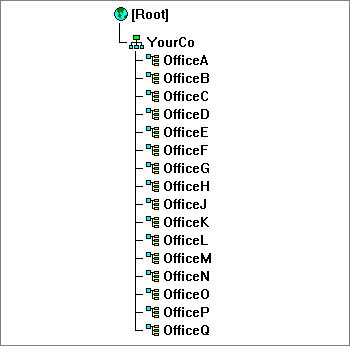
A flat tree produces inefficiencies that have to be overcome by NDS processes. These inefficiencies can lead to poor performance and a less user-friendly environment for users and administrators.
To avoid the inefficiencies of a flat tree, create intermediate containers that subdivide the tree, usually into regions, as shown below.
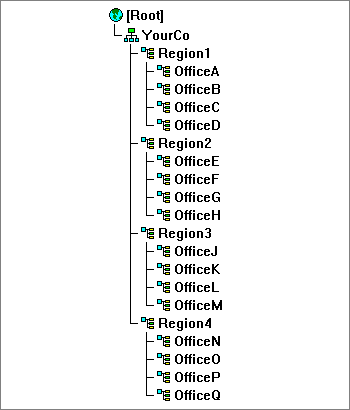
You may need to further subdivide the tree to restrict partitions to about 1,000 objects. After designing of the upper levels of the tree, plan workgroup containers and leaf objects.