Discussion group replication is the process of exchanging and transferring articles and discussion groups between servers. Your server can send to any remote server, and any remote server can send to your server. To accept incoming discussion groups, each server must be configured to do so. Thus replication is a two-way exchange of discussion groups coordinated by the server administrators.
The following illustration shows an example of replication.
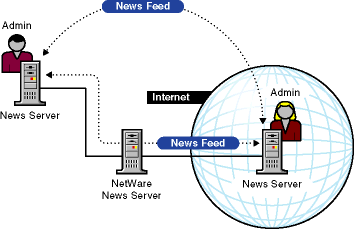

Discussion group replication does the following:
For more information on Usenet, refer to About Usenet.
For example, you could have servers in several different buildings that share discussion groups.
There are two types of replication relationships between servers:
As peers, both servers can spool posted articles and send and receive replication feeds to and from one another and other servers. You can, however, receive discussion groups from a server and not send discussion groups to that server. You just need to specify which outgoing discussion groups to send to other servers in the Configure Replication Host form (from the News Server interface, click Discussion Replication > Configure Replication Host).
You cannot control which incoming discussion groups your server receives. You do control, however, which discussion groups your server supports. If your server does not support the discussion group sent by the other server, all the articles in the discussion group are rejected by your server. You use control articles to accept or reject incoming discussion groups. For more information about control articles, refer to Understanding Control Articles.
To host the same discussion groups on your server that are being sent by another server, you should obtain the server's ACTIVE file and import the desired discussion groups into your server's ACTIVE file.
As master and synchronized replica, one server is designated as master server, and one or more servers are designated as synchronized replicas of the master server.
Only the master server can spool posted articles and can send and receive replication feeds to and from other servers.
The synchronized replica
The master server then sends the articles to its synchronized replicas.
Master and synchronized replication is a way to help balance the load of your news servers. This setup allows users to maintain the same seen/unseen state for articles, regardless of which synchronized replica they use.
If you want to receive global discussion groups, you will want to receive the Usenet feed. Usenet is the public collection of newsgroups. These newsgroups are sent around the world, and their articles are stored on many servers. Not all news servers receive a full news feed, that is, they don't give you access to all Usenet newsgroups because the server administrator has not configured the server to receive a full news feed.
If you're new to the Internet or Usenet newsgroups, you might want to buy a book that lists and describes all the Usenet newsgroups. (The list is very long.) Or you can subscribe to one of the newsgroups that publishes lists, such as news.announce.newgroups and news.announce.newusers.
Usenet addresses look similar to Internet addresses, but the most general category appears first instead of last. For example, rec.pets.cats is about cats, but the general category is about recreation.
Usenet newsgroups are organized into the following groups:
If you set up discussion group replication, you need to understand certain access control and security issues.
If your News Server sends discussion groups to external or internal sites that use another method of access control, you cannot control access to the discussion groups residing on the remote server. If you are concerned about access control for the discussion groups you are sending, make certain that you trust the remote site.
Incoming Discussion Groups
To receive encrypted data or to replicate discussion groups with remote servers that have encryption enabled, the server must have a valid certificate and must have encryption enabled. When you replicate discussion groups with a remote server that has encryption enabled, all data between the two servers is encrypted. Keep in mind, however, that after the articles have transferred to the other server, the articles are only as secure as the remote server.
Outgoing Discussion Groups
The News Server can send encrypted or unencrypted data whether running with encryption enabled or not. Additionally, the server can send encrypted private discussion groups and unencrypted public discussion groups. The receiving server determines whether the transmission should be encrypted. You configure the server to use the receiving server's port number and SSL setting for transmissions.
News Server can send to a port number other than the one it listens to. This feature, however, does not guarantee that you can receive discussion groups from the remote server. To send to your server, the remote server must have the ability to send to a port number other than the one to which it listens and must be configured to send to your server's port number.